Sit-Stand vs. Fixed Desks: Which One Fits a Small Home Office?
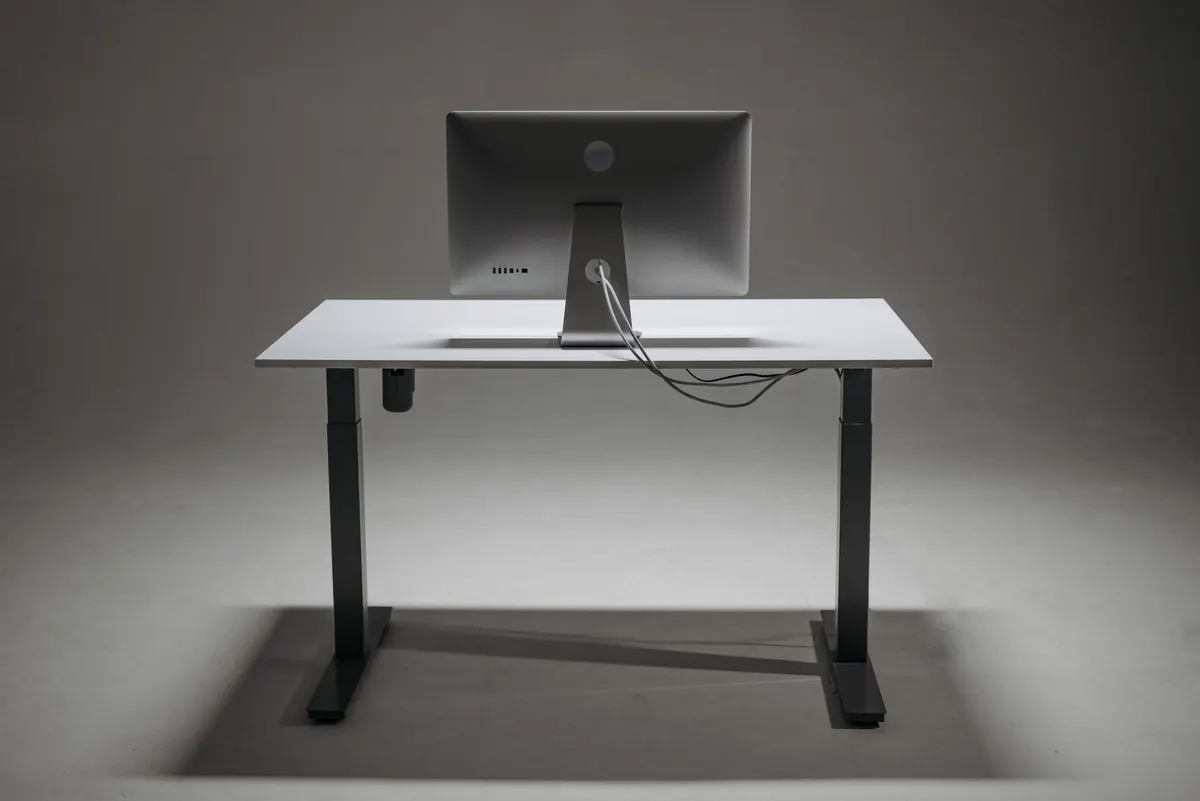
A small home office makes the decision for you sooner or later. You measure the wall, picture the chair, move the lamp twice, and then discover the desk you liked leaves almost no room to walk past it. That is usually when the sit-stand question shows up.
Sit-stand and fixed desks ask different things of your room, your budget and your habits. Standing desks promise movement; fixed desks promise simplicity and a lower price. In a small space, the deciding factor is rarely the technology. It is whether you will use the feature you are paying for.
Footprint: What Each Design Actually Takes Up
An electric sit-stand desk moves vertically, so its footprint stays much the same: the same top, plus a frame underneath, a controller and cabling with enough slack to travel. Two details matter in a tight room.
The legs and crossbar often sit inboard of the top, which can eat into knee space or block a radiator and a slim filing cabinet behind. Cable management also needs planning, because draped cords snag the moment the desk rises.
Fixed desks, particularly simple four-leg or trestle designs, usually have a lighter, shallower frame and leave more clear space underneath. A 48-inch by 24-inch top is a common compact size in both categories, but the fixed version tends to feel less crowded.
One measurement people skip is the height range. You want the surface near elbow height with your shoulders relaxed, sitting or standing. If you are tall, check the desk goes high enough. If you are shorter, check it drops low enough without forcing a raised chair and a footrest.
Cost: Where the Money Goes
Sit-stand desks cost more because you are buying a mechanism: lifting columns, a motor or two, a controller and the engineering that keeps the whole thing from flexing. A powered frame usually runs above a comparable fixed frame, and the cheapest models cut costs on stability and speed rather than on the desktop.
Compact models are not automatically cheaper. Squeezing a lifting mechanism into a narrower frame sometimes adds a premium, which surprises buyers who assume smaller means less expensive.
Crank and pneumatic desks sit in the middle. They cost less than electric models and need no outlet, but adjustment takes effort, so owners raise them less often. Remember the rest of the setup, too. A good chair, a footrest and proper lighting shape your working day more than the lift mechanism alone.
Stability Is the Quiet Dealbreaker
Wobble is the most common complaint about budget sit-stand desks, and in a small room it is more noticeable because you are likely to brush against the desk when you turn around.
What separates a steady desk from a shaky one:
- Column design. Two-stage columns are usually stiffer than three-stage at the same price. Three-stage reaches higher and lower, but flexes more.
- Top thickness and material. A thicker top resists flex. Thin laminate over a light core ripples when you type.
- Bracing. A crossbar or side brackets add rigidity, though they also take up space under the desk.
- Floor contact. Adjustable feet matter on old floorboards and uneven tiles.
Test a display model if you can: press down on a front corner, then type on it. Buying online, look at the desk's own weight and the frame material instead of phrases like "rock solid". At equal money, a fixed desk with a solid top and four legs is almost always the steadier choice.
How Often Owners Actually Raise the Desk
This part of the comparison never appears on a spec sheet. The usual pattern is an eager first few weeks, then a gradual drift back to sitting, with standing reserved for phone calls, a mid-afternoon reset or the twenty minutes after lunch.
That is not a failure. Alternating positions is the point, and nobody sensible stands for a full working day. But it changes the math. Raise the desk twice a day and a crank model will do. Switch several times a day and electric memory presets start to earn their price.
Before you buy, run a one-week experiment. Put your laptop on a kitchen counter or a stack of books and work standing for twenty minutes a few times a day. Note how often you actually do it, and how much you missed a keyboard at the right height. That number tells you more than any product description.
Friction matters as much as motivation. If raising the desk means moving a mug, unplugging the laptop and waiting fifteen seconds, you will stop doing it. Presets, a clear desktop and one tidy cable bundle all make the standing position easier to reach.
When Each Desk Wins
A fixed desk usually fits better if…
- You need to walk past the desk, not around it.
- Your work is mostly seated and focused, with breaks taken away from the desk.
- You would rather put the difference into a better chair.
- You like a simple, solid surface with no cables to manage.
- A standard desk height already suits your body.
A sit-stand desk earns its space if…
- You already stand up for calls or pace while thinking.
- You have a corner for the frame and can route cables once, properly.
- You will use it most days rather than as a novelty.
- You want a surface that drops low for laptop work and rises for reading.
Making Either One Fit a Small Room
Depth matters more than width. A 24-inch deep top keeps the desk off your chair and preserves floor space; 20 inches works if you use a monitor arm instead of a stand.
A wall-mounted or corner desk removes legs from the floor plan entirely and often costs less than a powered frame. A fixed desk on locking casters can be rolled aside when the room needs to be something else. And one screwed-on cable tray keeps cords off the floor and out of your chair's way.
A Practical Way to Decide
If you can spare the budget, the depth and the cable discipline, and you know you will raise the desk most days, a sit-stand model is a reasonable buy for a small office. If any of those is uncertain, a fixed desk plus a good chair and a habit of standing up every half hour gets you most of the benefit for less money and less visual clutter.
If back, neck or wrist pain is the reason you are shopping, treat furniture as one small variable. Speak to a doctor or physiotherapist about what is actually going on before spending on a mechanism.
Whichever you choose, measure twice, sit at the planned height before you commit, and leave yourself room to push the chair back. In a small office, that last six
Photo: Pavel Danilyuk / Pexels